
Notes from a Winter Escape
On giant cacti and those of us who feel crushed by capitalism.

A couple of months ago, I grew sick of that damn snow and booked a last-minute trip to Tucson, Arizona, mostly to spend time in Saguaro National Park. A friend told me this was dramatic, considering I had been in Los Angeles just weeks before. Maybe it was, but I had felt completely overwhelmed by the feeling of snow (and life) closing in on me.
NYC is a huge, diverse city of weirdos. I love it, but it’s felt challenging recently for me. I’ve noticed a kind of eerie homogenization around me. People inject themselves with Ozempic, flock to pilates classes in matching sets, adorn themselves in markers of wealth and talk about the same books and shows. There is a fascistic element to their uniformity.
On a recent jog along the Hudson, I had something like a small panic attack as the hordes of super-fit, expensive-outfit people passed me. It wasn’t being passed that bothered me. It was feeling alien, surrounded by the smooth-skinned, creepily identical humans. I almost felt like H.G. Wells’ Time Traveler, surrounded by the blonde, pleasure seeking, Eloi. Their perfection felt non-human.
Winter in the city has contained a series of anxiety-provoking moments like this one for me.
It’s hard to pinpoint the root of my winter depression — the gray skies, piles of snow, job frustration, self-optimization zombies, my neighbor’s daily screaming through the thin walls of my small apartment, a bit of loneliness, or the totally unnecessary mass murders our government commits every day. Since watching my dad die a few years ago, I am at least a little bit sad most days; it’s probably some combination of all of it.
And so, I went to the desert for a week. I had dreamed of standing among the saguaro cacti, even if I had to travel alone.
These beautiful, strange, almost human-like giants exceeded anything I had imagined. On my first morning, I sat in the warm sun drinking a cold brew with café de olla spices and cried. I felt relieved feeling the sun again. I felt a lot of gratitude to be able to drag myself across the country really just to wake up in the hot sun.
The first morning driving into Saguaro National Park took my breath away. The park is a densely packed saguaro forest, and I was lucky to experience it dotted with wildflowers, mostly poppies and desert zinnia because it had rained the week before. It was shocking to see the sheer number of saguaros—a species I had never even seen before. I was still on Earth and meeting a new “people.” They were a living thing I could not have previously imagined experiencing. Our planet is miraculous in that way. We think we know so much about life, and yet, we kind of know nothing at all.
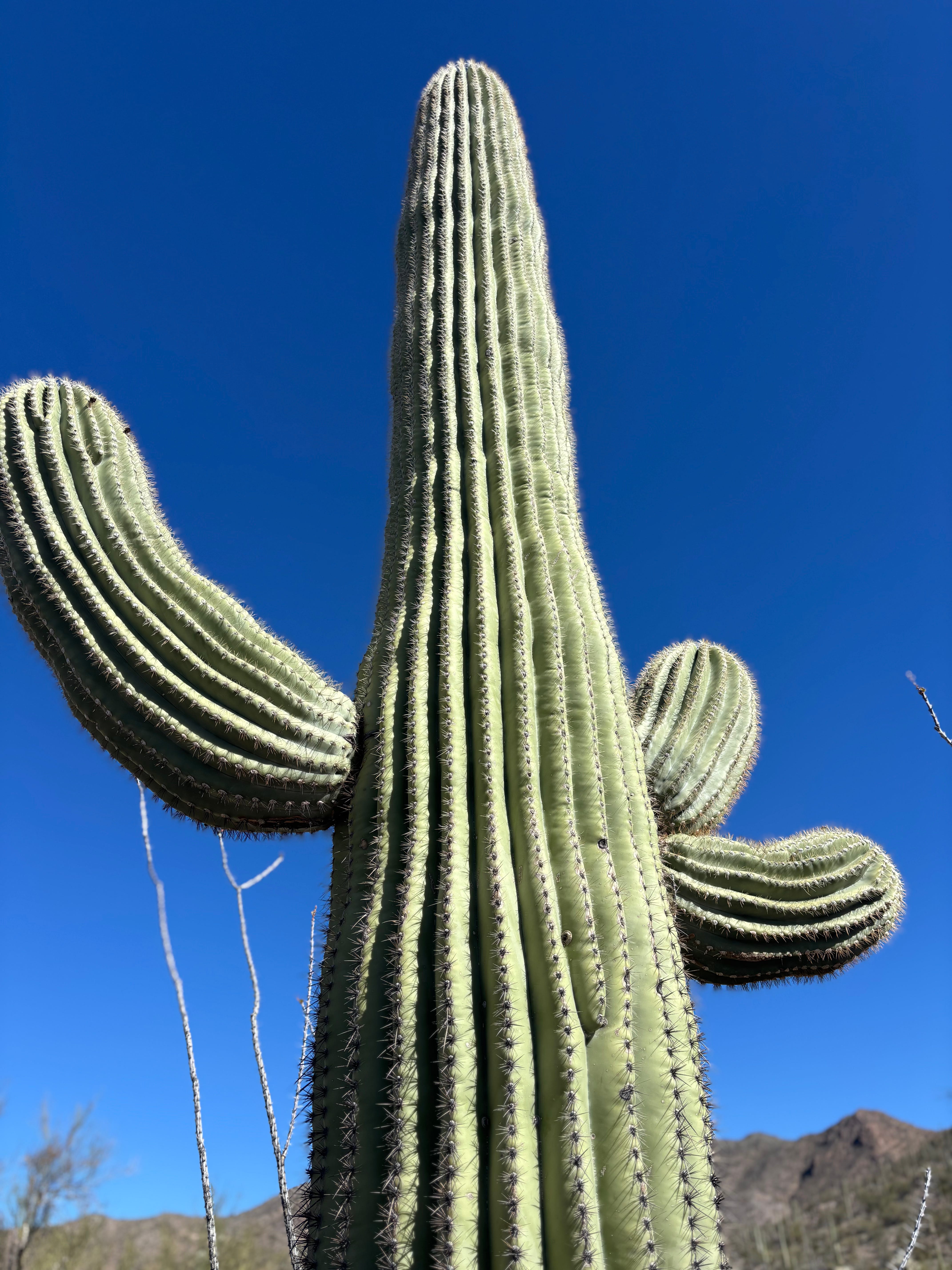
Saguaros only grow in a very specific section of the Sonoran Desert ranging from mostly central Arizona and Sonora, Mexico, and they grow incredibly slowly. They’re temperamental, and they die if it gets too cold or if they get too little rain. Their iconic arms only begin growing after about 70 years of a saguaro’s life. They are considered adults at about 125 years of age and could be about 50 feet tall. Strange beings!
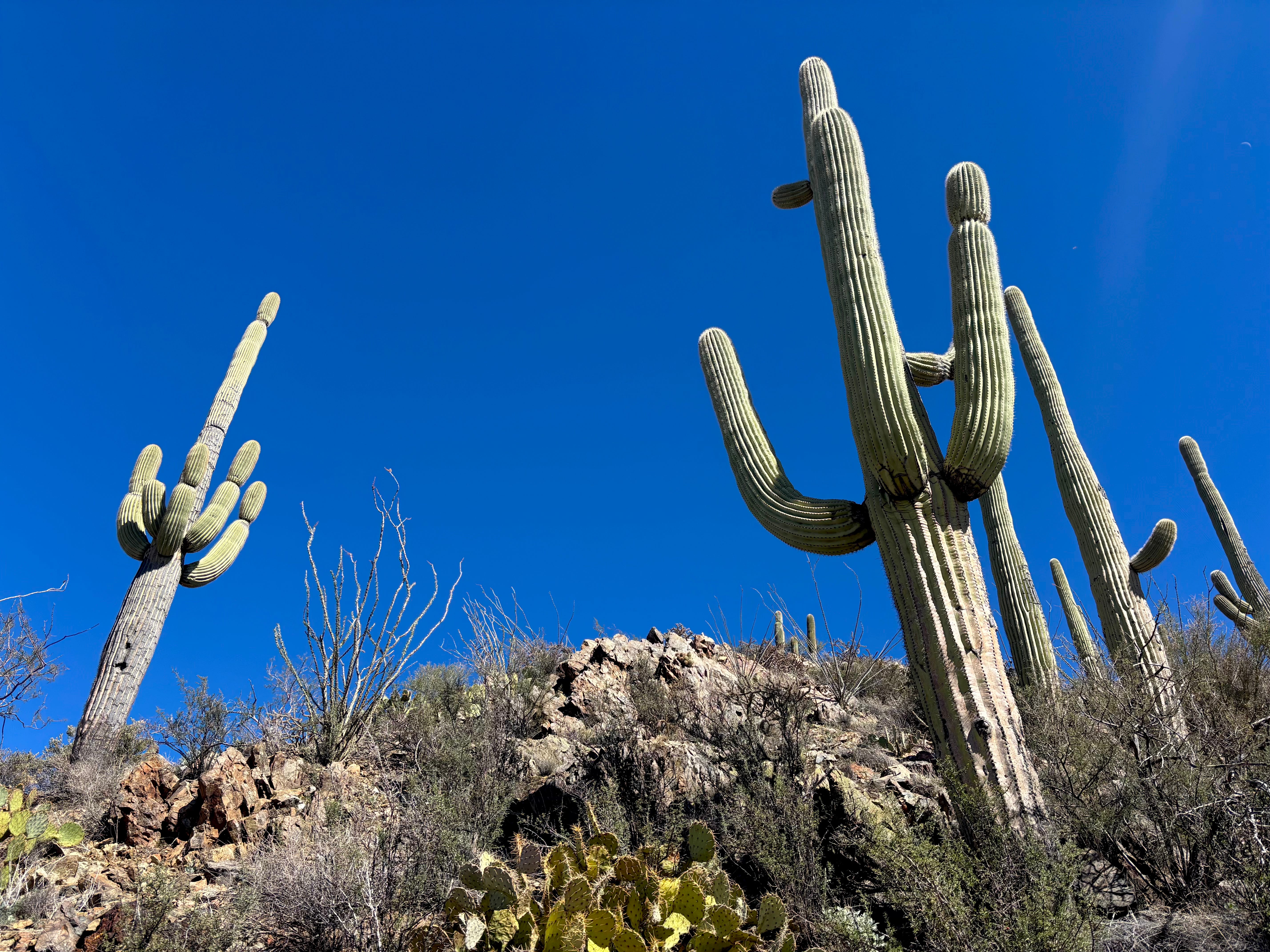
These giant cacti grow on Tohono O’odham land. The Tohono O’odham see the saguaros as kin and believe that the saguaros are their ancestors. They also harvest saguaro fruit in June and use the woody ribs of dead saguaros for their homes and fences.
The saguaros certainly all have their own personalities. Some seemed dramatic and ostentatious, while others were graceful or even shy. My time among them, when I was technically alone, felt warmer–physically and I guess spiritually—than the past few months for me in NYC. I’ve written before about building community with all living things.
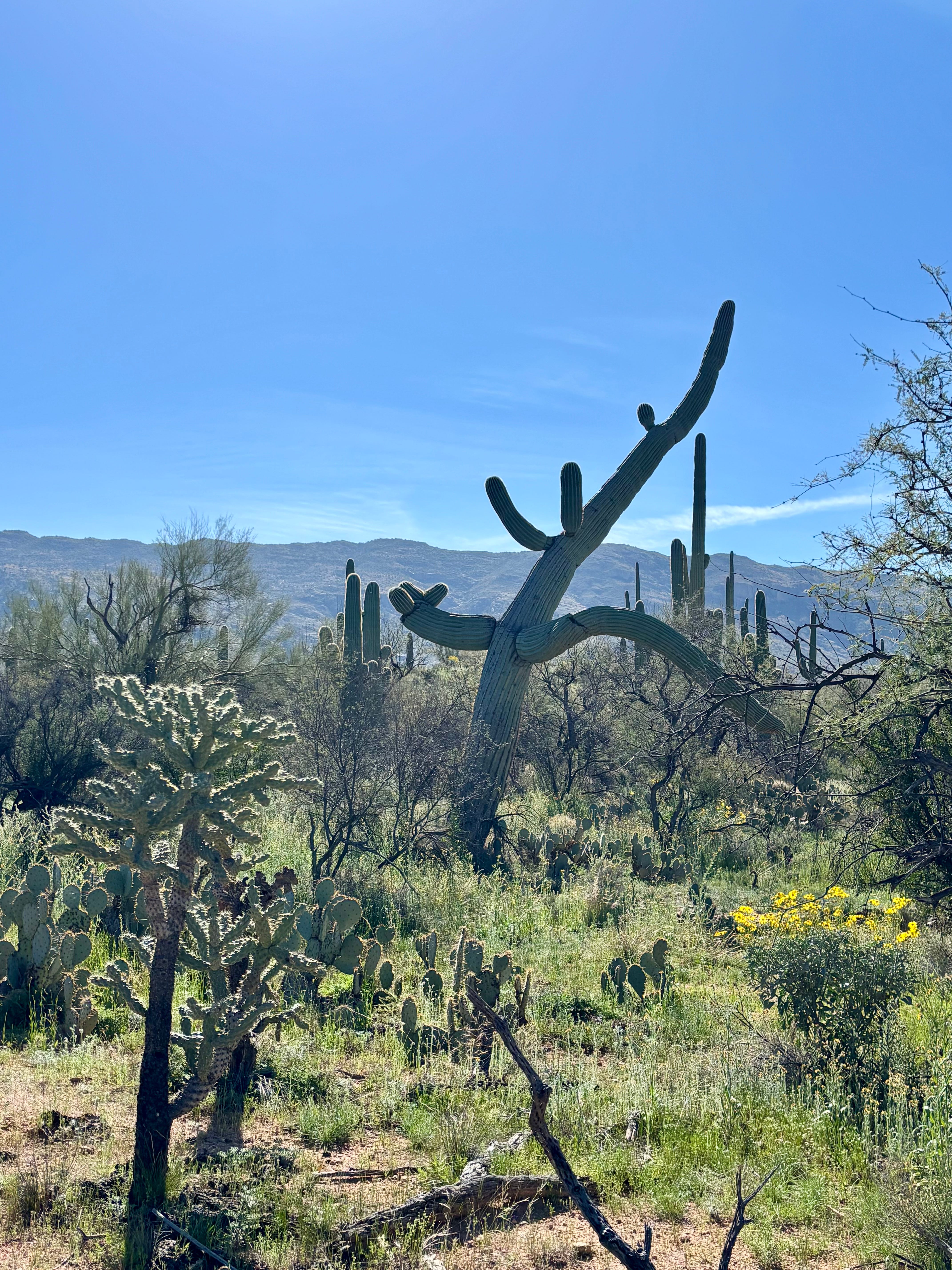
Here, in the desert, I was so in awe of these giant cacti that I wanted to hug them. I didn’t for obvious reasons. I learned years ago, while tripping on LSD in the gorgeous Huntington Gardens, outside of LA, that if you touch a cactus, even one that looks cute and fuzzy, it will not only prick you, but unleash several very tiny and painful needles into your skin. The pain of the needles will be felt long after the trip has ended.
Tohono O’odham poet Ofelia Zepeda wrote of the land now called Tucson, known in Tohono O’odham as Cuk Ṣon:
The true story of this place/ recalls people walking/ deserts all their lives and continuing today, if only/ in their dreams./ The true story is ringing/ in their footsteps in a place so quiet, they can hear/ their blood moving/ through their veins.
It’s true. When you get away from fellow hikers, it is so quiet. I took hours long hikes and felt surrounded by these strange giant green non-human people, and they didn’t say much. I passed hawks, javelinas and desert hares and felt I could just be myself.
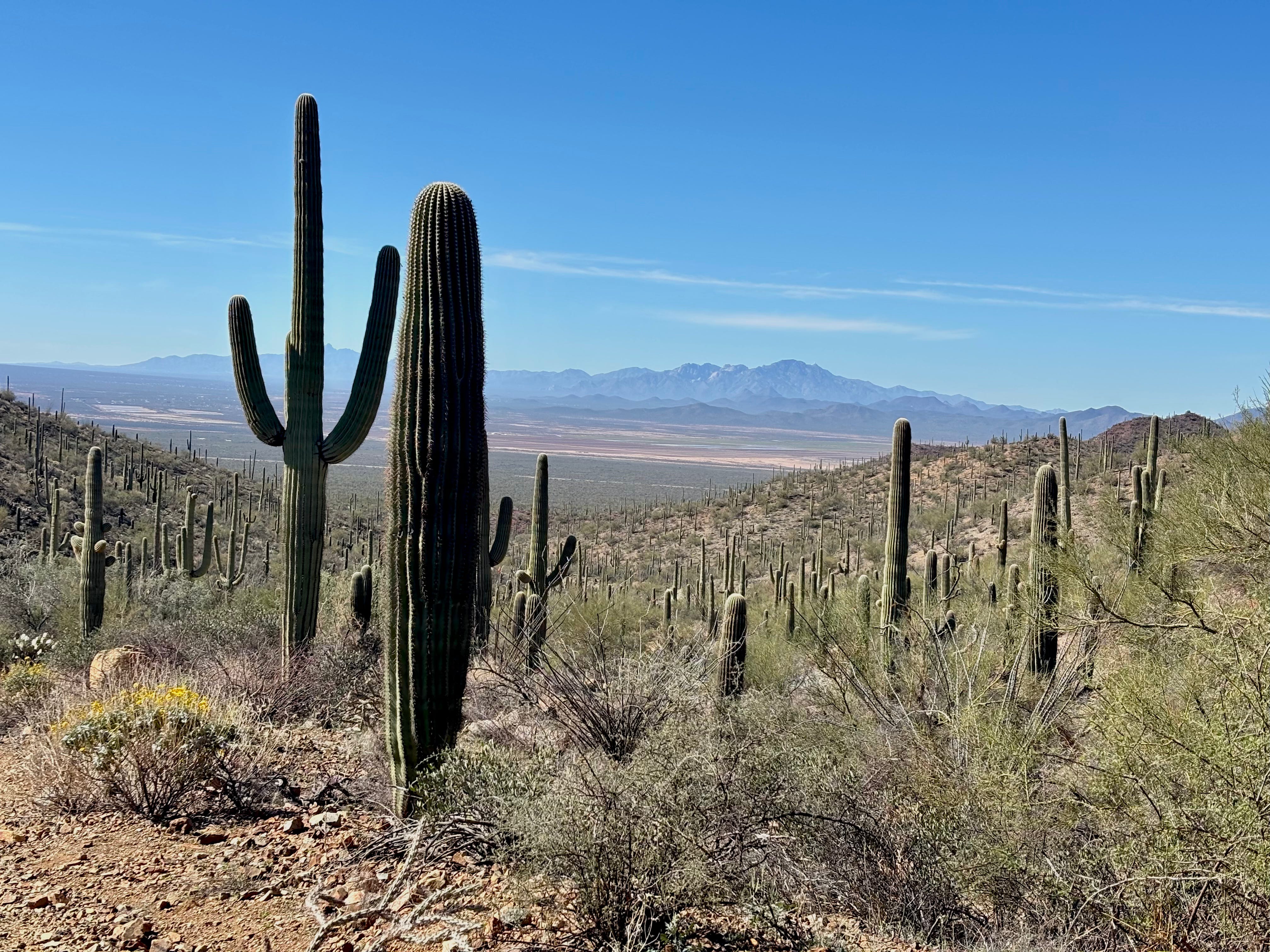
Our saguaro cousins are strange looking and eccentric. Some are deformed, bumpy, blemished. Some visibly decaying, crested, lopsided. Some are postcard-perfect — tall, beautiful, evenly spiked. All of them sustain life as the desert’s keystone species. All house woodpeckers and bees, and all produce sweet fruit for the Tohono O’odham.
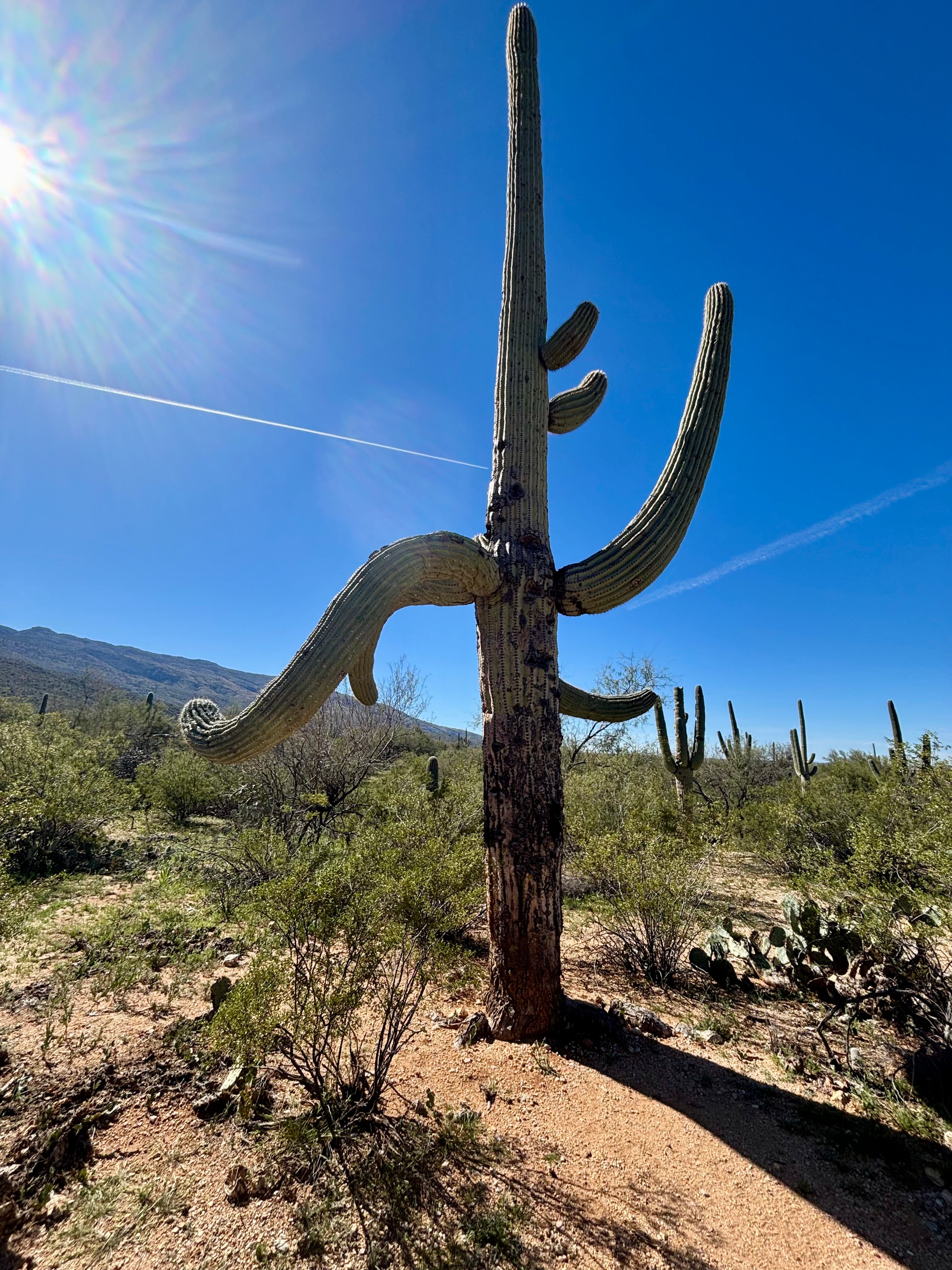
During my winter escape, the hot sun kissed my skin, while wild poppies hypnotized me. They reaffirmed my connection to the living, even while I am still struggling to feel fully connected to myself back in NYC. I am trying to locate the size of my sadness in the scale of existence because I know that I am not special.
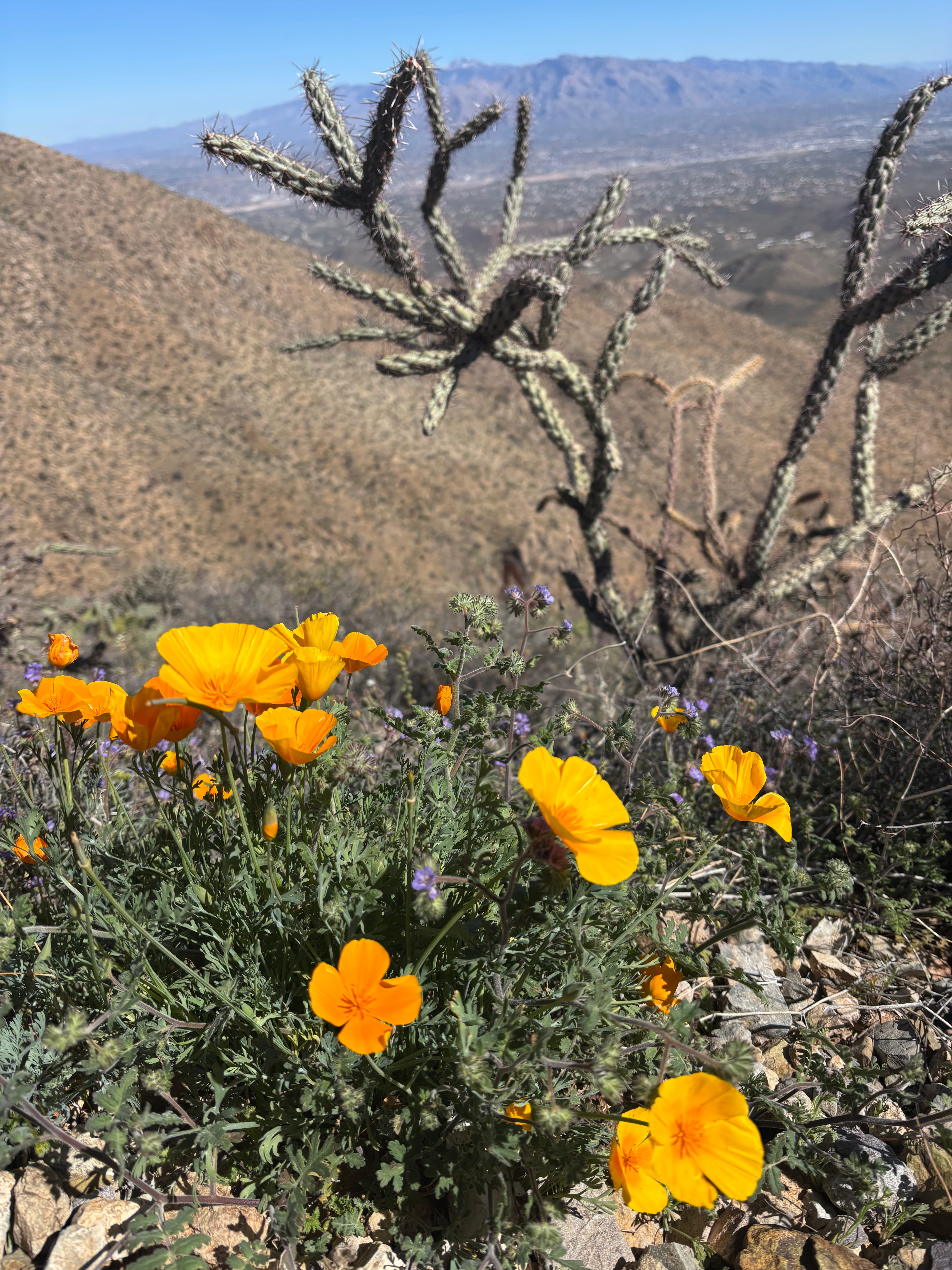
I think that because of the trappings of consumerism, many in our collapsing empire feel more connected to themselves and their own desires than they do the rest of life, whether it be to their neighbors who sleep on benches along their jogging routes or their friends who struggle through grief and poverty. Capitalism isn’t soul crushing for us all equally. Some “successful,” colleagues or friends from young adulthood, thrive under capitalism. Their souls seemingly remain intact even as they too witness genocide. They’re excellent at living life in ways that are personally fulfilling even at the expense of those around them. They might be fine living an entire lifetime in which no change happens in this world. I envy them a bit. They often have a stronger sense of self than I do in ways that better suit our manmade capitalist world.
But I know that many, like me, feel crushed by this world and are a bit unsure of how to cope in it. I’ve read plenty of political theory that helps me understand the structure of capitalism and how the system sustains itself, but I am interested in exploring what capitalism feels like. It doesn’t feel good.
Our society doesn’t feel like a saguaro forest. Cities feel dense with capital and monotony and can feel isolating when you don’t give a shit about either, even though cities are filled with the living too. At my most irrational, I have wondered if I am an alien. Perhaps Sun Ra was right when he told us he was from Saturn, and there are more of us who were dumped here too. That’s probably untrue though; what feels alien is devotion to capitalism.
This system born from the institution of chattel slavery requires human detachment to function. Resisting our own dehumanization often feels like suffering. We are told our questioning makes us preachy or negative, but perhaps it simply means we have remained human animals. In the desert, the saguaros and javelinas did not ask me to seek unattainable perfection. They just lived.
I did try to disappear into the desert, and it reminded me that I am still tethered to other humans.
A strange thing happened in Arizona. I ducked into a small bird aviary at a park outside Tucson minutes before it closed. The birds were mostly hidden in the branches, and I turned to leave. As I did, I ran into my stepbrother — someone I have only met once or twice in my life. He lives in the Midwest. I doubt we have much in common beyond a shared accident of family. And yet there we were, two humans, standing together in a random aviary, with very few birds.
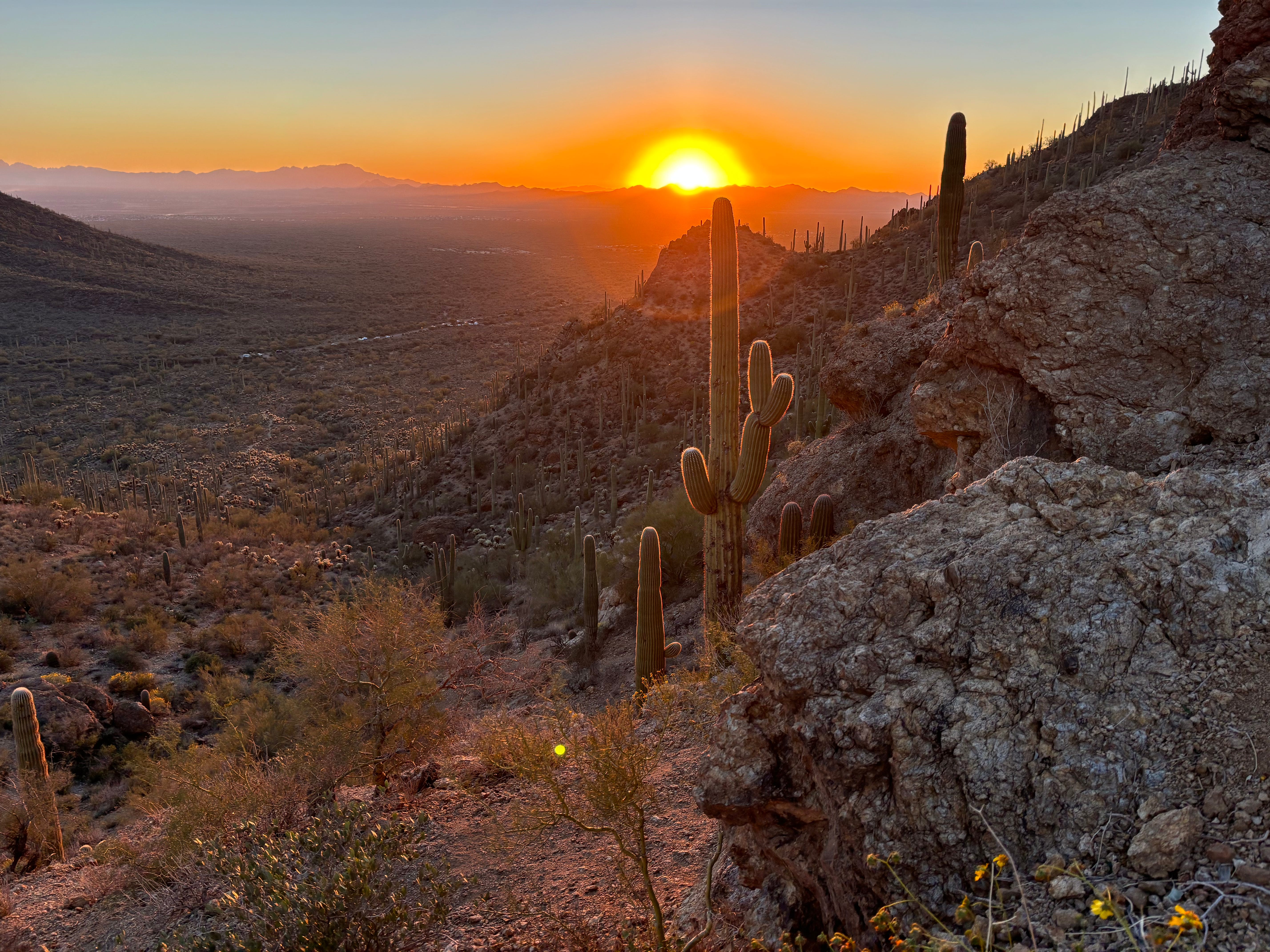
It was not magical. It was a reminder that the world is both vast and small. We are connected to everyone and everything in this Cenozoic era or “Age of Mammals.” There is no escape from the human world, even if I disdain this world as it is now in its most unnatural, capitalist—Anthropocene if you’re feeling apolitical— state. So then, what do I do?
The answer is unclear, and luckily, it is not yet all yuppy homogeny back in NYC.
I visited my SNCC friend, Dottie, after my Arizona trip. We ate soup, and I told her about my travels. She was fascinated by my hotel room’s Book of Mormon, as I recounted it was the first one I had ever seen in real life, so spent a couple of evenings perusing the bizarre book. I told Dottie that Mormons believe that Jesus came to America and that according to them, the Garden of Eden is in Missouri. She thought I made this absurdity up, and she could not stop laughing. She told me she was glad she made it to age 88 without knowing that nonsense.
She then shared stories from her youth with me, even recounting her time visiting 1950s Moscow with a delegation of young communist students when she was a teenager. There have always been people who made righteous attempts to resist capitalism and remain human.
I don’t have any words of wisdom or political insights. I don’t know whether humanity can or even should survive under the devastating conditions we have built. Life will persist on this planet, even in odd forms like saguaros, whether we’re here or not.
I only wish to say that I see and relate to many of my anti-capitalist—be they Marxists, anarchists, whoever—brothers and sisters who feel crushed by this painful and violent system. I am privileged enough to live in a home that is warm and not constantly bombed. I am moved by the desert, and I am grateful that I am a feeling human, able to feel sadness for the world, even when the pain is unbearable.
I recognize that I am fortunate enough to take myself on adventures, even small ones, and next week I am going on a pretty spectacular one through one of my ancestral homelands, Mississippi. More on that another time…. I hope we all strive to remain human wherever we may find ourselves.
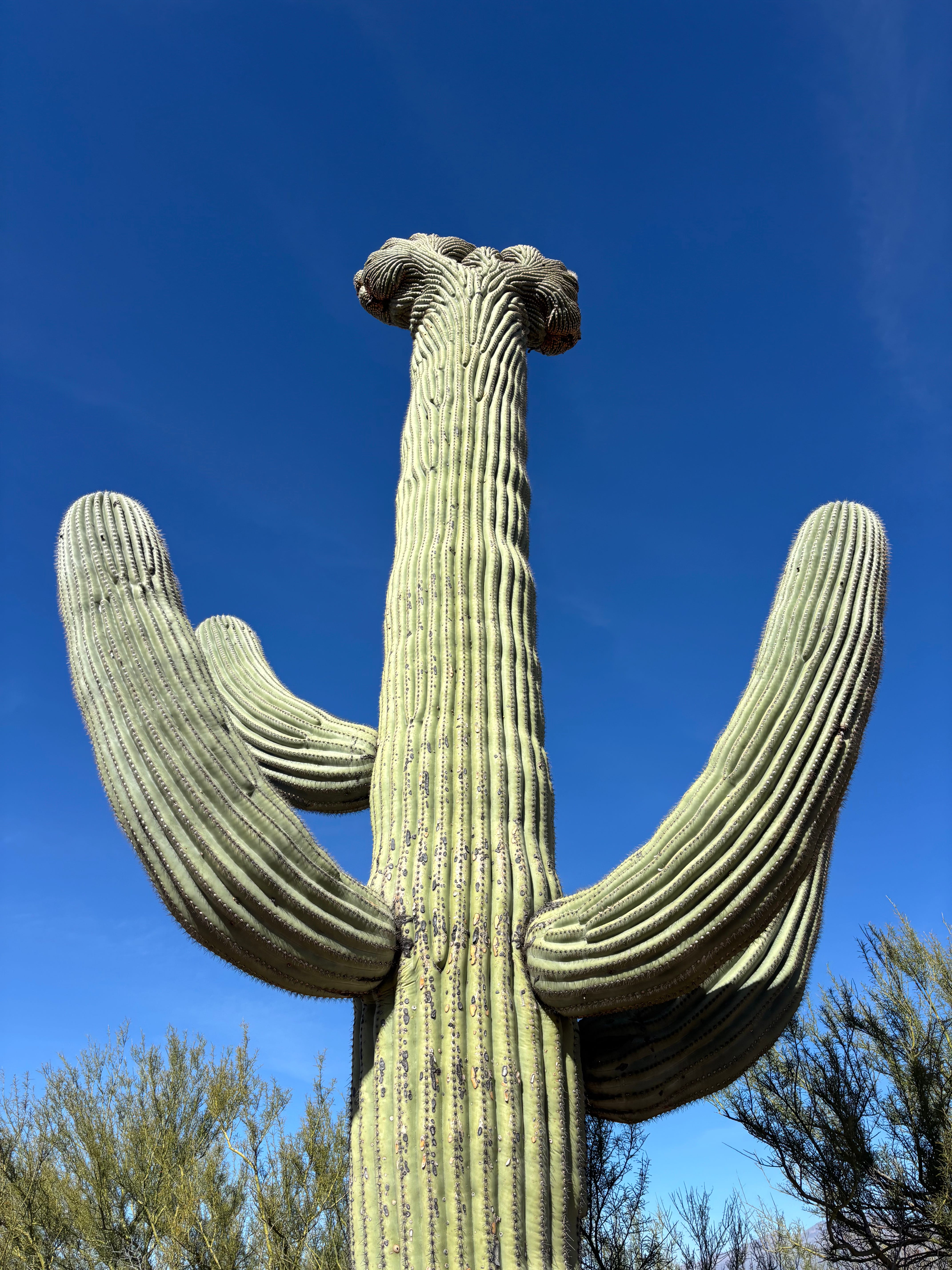
**Haven’t shared a playlist in awhile. Here’s my Tucson driving playlist, with the addition of a song from Mitski’s new album. A random, shuffle-type playlist.**
I live in Tucson! You should have dropped by and said hi.
Seriously, it really is a magical place. Living here and focusing only on the negatives tends to make one forget that. Sometimes it takes an outside set of eyes as a reminder.
I suggest following @kimieisele (https://kimieisele.substack.com/); she does a lot of good stuff here, to include the Standing with Saguaros writing workshops.
I read this post in the morning and been thinking about it all day. Thank you for sharing